
Where art meets ecology
By Nikki Babri and Sofia Feeney
Driving south on I-5, Professor James Nisbet had made the trip through Orange County many times before. But this time, something clicked. As Highway 1 crossed into Marine Corps Base Camp Pendleton, suburban development gave way to open coastal landscape.

“I thought about the dramatic alteration these lands have experienced in the past several hundred years,” recalls the professor and chair of the Department of Art History and Ph.D. Program in Visual Studies. “I’d been doing a lot of thinking about the role of public institutions as spaces for contemplating environmental issues, and the way that UC Irvine Langson Orange County Museum of Art could serve as a space to think about and grapple with changing environmental conditions in the places we live.”
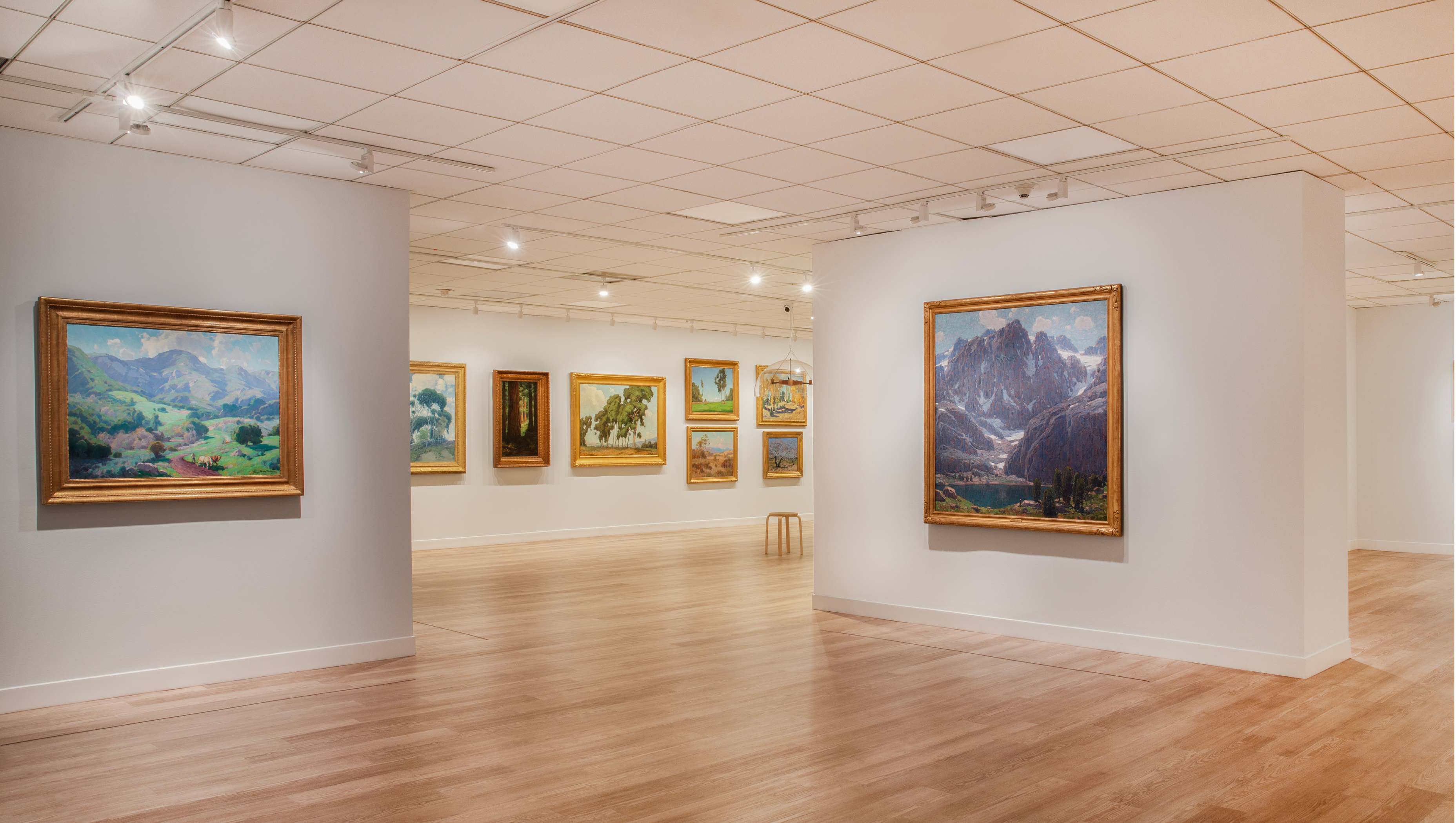
That roadside revelation led to “Habitat: Making the California Environment,” the first exhibition displayed at the newly formed UC Irvine Langson Museum. On view through January 10, 2026, the exhibition reimagines late 19th and early 20th century California landscape paintings as ecological time capsules, redefining California nature not as an undisturbed wilderness but as a habitat that has evolved through the presence of people, animals, plants and other living elements.
Interdisciplinary collaboration at the core
What distinguishes “Habitat” is its deeply interdisciplinary approach, reflecting Nisbet’s conviction that addressing the climate crisis requires collaboration across fields.
“This exhibition was shaped by years of interdisciplinary conversations and connections at UCI, both across different fields of study in the School of Humanities and across campus,” explains Nisbet, who previously directed UCI’s Environmental Humanities Research Center and whose research focuses on ecocritical approaches to modern and contemporary visual art.
He needed someone who could identify plant species in century-old landscape paintings. Through campus connections, all roads led to Justin Felder ’25, a California Certified Field Botanist who recently completed his master’s in UCI’s Conservation and Restoration Science program. “I’ve never embarked on a project like this before,” Felder explained at the exhibition’s opening, “but I saw it as a welcome challenge.”
Felder’s botanical expertise helped reveal invisible stories. In Curtis Chamberlin’s 1915 painting The Old Coast Road (Arch Beach Road) – depicting what is now Highway 1 between Laguna Beach and Crystal Cove – he identified native coastal grasses that have since vanished from the region. The painting captures a moment of transition as a newly constructed roadway winds through open hillsides that today support dense coastal development.

Sound as ecological witness
Felder’s discovery of the missing coastal grassland inspired the exhibition’s most innovative element: an immersive sound installation by intermedia artist and composer Andrew Weathers. The collaboration emerged through Dr. Marianna Davison ’22 (Ph.D. Visual Studies), Nisbet’s former doctoral advisee and a postdoctoral scholar in Art History who has worked with him for years on interdisciplinary climate and arts initiatives.

Weathers proposed a sound piece that responds to Chamberlin’s painting and the actual site it depicted more than a century later. The result is Landscape Hocket (Orange County) (2025), an hour-long composition split between two sound domes installed in the gallery.
In the gallery, visitors use both sight and sound as they consider Chamberlin’s painting. “We are hearing rush hour traffic from the perspective of the guardrail and plants along the PCH, the rustling of underwater creatures, the force of crashing waves and the chatter of birds and beachgoers,” Davison, a producer on the piece, explains.
Using five audio devices – condenser and shotgun microphones for atmospheric sounds, a hydrophone for underwater audio, a contact microphone for surface vibrations and a geophone for inaudible vibrations through rock and other materials – Weathers captured field recordings at five locations along the Pacific Coast Highway over a five-day period. The “hocket” composition, referencing a medieval technique where voices alternate to create a staggered but seamless soundscape, weaves these recordings into what Weathers describes as “a kaleidoscopic landscape.”
When visiting Chamberlin’s actual painting site, Weathers and Davison were reminded of California’s climate crisis firsthand as they encountered remnants of black and charred trees from the 2022 Emerald Bay fire. But they also felt a pang of hope when they noticed a newly established “fire break” planted with native coastal prickly pear to slow encroaching flames. “It affirmed for me that a return to native plants and Indigenous-led stewardship is the way forward,” Davison shares.
Confronting colonial legacies
The exhibition is organized into five thematic sections – Native Blooms, Orange County, Mountains, Missions and Arboreal Landscapes – each revealing layers of ecological and cultural transformation. The Missions section confronts California’s colonial past head-on, representing what Nisbet emphasizes as “the most challenging subject in the show.”
The paintings depict architectural and landscape elements, like pepper trees, palm trees and bougainvillea, brought and planted by the missionaries that have since become associated with California itself, despite not being native to the state. Operating from 1769 to 1834, the mission system forcibly severed Indigenous peoples from lands they had managed for millennia. Its botanical aftermath remains visible: invasive black mustard and non-native ornamental plants still transform entire ecosystems and contribute to California’s intensifying fire seasons.

The exhibition invites viewers to look closely and ask: How did this plant get here? How has it affected its ecosystem? Recognizing that many familiar California plants arrived only in the last 150 years creates what Nisbet describes as a “vexed feeling” about the need to address invasive species that propagate fire and displace native plants, while acknowledging the plants themselves aren’t at fault. “It’s not the mustard that brought itself here,” he notes. “We can’t be mad at a plant, right?” While the exhibition doesn’t answer this question, it directs critical attention toward the colonial systems that introduced these species.
Nisbet’s work with Tongva artist and botanist Samantha Morales Johnson Yang further informed the exhibition’s exploration of Indigenous stewardship. The forcible removal of Indigenous peoples by the missions fundamentally altered not just human communities but the landscapes themselves, he explains. The landscapes appear pristine and uninhabited – and suggest they have always been as such – but that perceived emptiness masks a critical, violent erasure.
Cultivating new ways of seeing
The paintings serve as inflection points between the beginning of colonization and California’s 20th-century suburbanization, prompting visitors to consider our future responsibility. “If a habitat is a habitat because of the involvement of every living thing within that environment, what’s our responsibility moving forward in continuing to shape the California habitat that we want to see?” Nisbet poses.
For Nisbet, the heart of “Habitat” lies in demonstrating that comprehensive understanding requires multiple perspectives – science, art, history and Indigenous knowledge working together to create something more complete than any single discipline could achieve alone. But his ultimate hope is that “the kind of looking that’s cultivated within the show carries beyond the museum and allows visitors to consider our contemporary California habitat in different, more critical ways.”
For more information about “Habitat: Making the California Environment,” visit imca.uci.edu or read Nisbet’s accompanying essay.
Interested in reading more from the School of Humanities? Sign up for our monthly newsletter.