

This section contains archived content made available for reference, research, or recordkeeping purposes. These materials are not actively maintained and may not meet current accessibility standards, such as WCAG 2.1 Level AA. If you need assistance accessing this content or require an accessible format, please contact sohwebmaster@uci.edu. We are committed to ensuring access for all users and will provide accommodations promptly upon request.
Join the Early Modern Iberian Worlds (EMIW) research cluster on Friday, April 3 at 11:30 AM for a Zoom workshop with professor Byron Ellsworth Hamann (OSU), who will be presenting chapters from his new book project, At the Butterfly House: Nahua Ambassadors in the Ruins of Rome, 1529.
This is a unique opportunity to read and discuss several chapters of this forthcoming work.
Please register via Zoom in advance to receive the meeting link and access to the pre-circulated chapters.
We look forward to seeing you there.
About the work:
Five hundred years ago, sixty-some Aztecs and Tlaxcalans and Cempoalans traveled from Mesoamerica to Spain with Hernando Cortés. Four of them continued on to Rome, met pope Clement VII, were granted papal bulls in support of specific Catholic churches in their communities back across the Atlantic, and then went home. However, mid-April 1529 was a very strange time for four Nahua pilgrims to visit Rome: that holy city had been sacked by imperial troops two years earlier and was still visibly in ruins. Not incidentally, one of the Nahua pilgrims to Rome in 1529, Hernando de Tapia, was from Mexico-Tenochtitlan, another holy city devastated in the 1520s. The readings for this workshop focus on the papal paperwork generated by the Nahua pilgrims to Rome: the draft-supplication as well as the four papal bulls it generated in support of Catholic churches in specific Nahua communities back in Mesoamerica. By situating these documents within the multisite bureaucratic-architectural infrastructures of the Vatican, we can see the profound investments in the conflictive politics of late 1520s Mesoamerica being pursued by the Nahuas in Rome in mid-April 1529.
About the author:
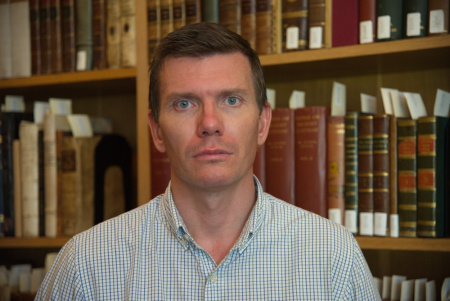
Byron Ellsworth Hamann received a dual PhD in Anthropology and History from the University of Chicago. His research focuses on art and writing in pre-Hispanic Mesoamerica and the connections linking the Americas and Europe in the early modern Mediterratlantic world. An editor emeritus of Grey Room, he is author of The Translations of Nebrija: Language, Culture, and Circulation in the Early Modern World (2015); Bad Christians, New Spains: Muslims, Catholics, and Native Americans in a Mediterratlantic World (2020); The Invention of the Colonial Americas: Data, Architecture, and the Archive of the Indies 1781–1844 (2022); and coeditor (with Felipe Rojas and Benjamin Anderson) of Otros pasados: Ontologías alternativas y el estudio de lo que ha sido (2022).