
60 years of writers
By Nikki Babri
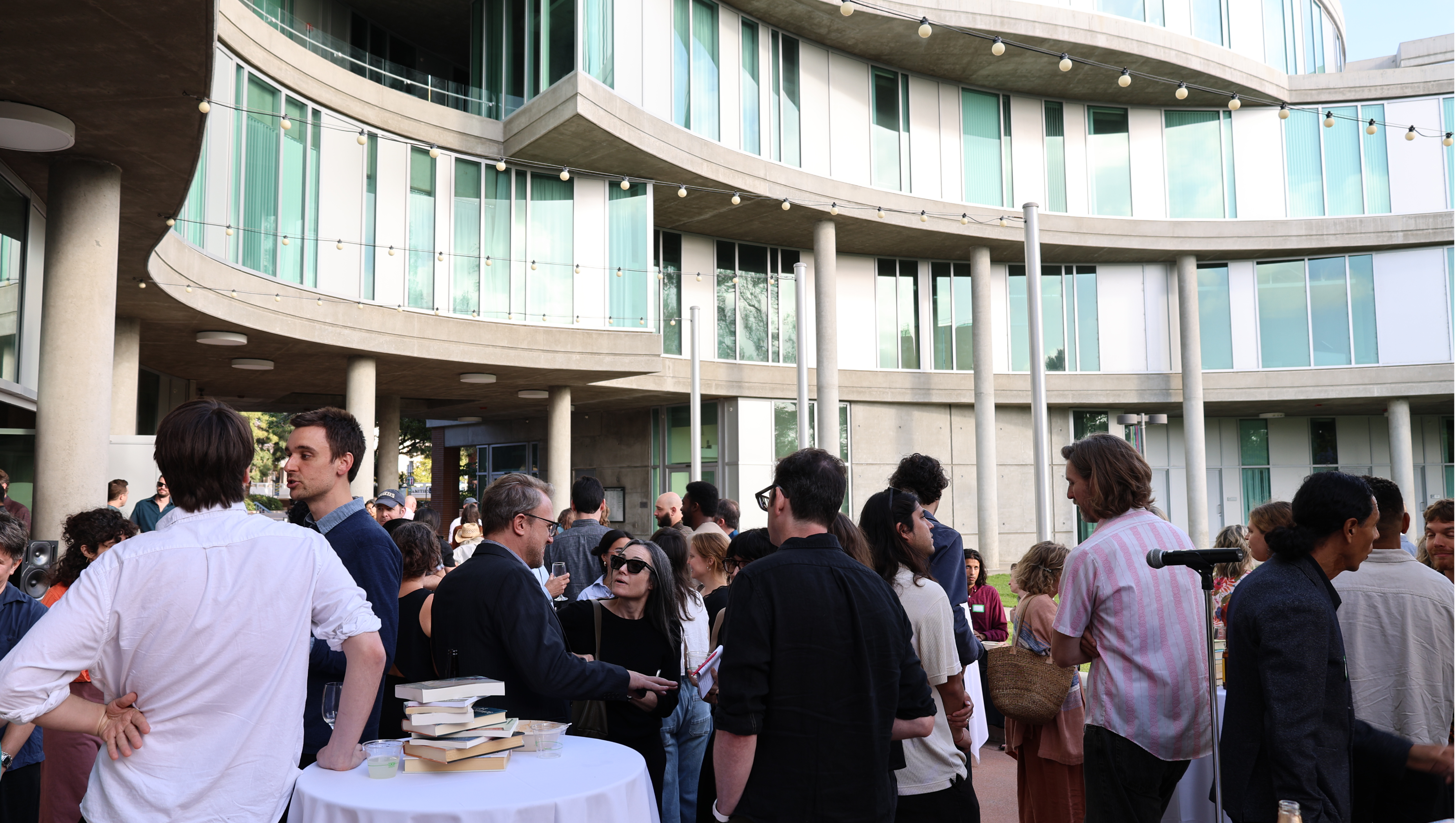
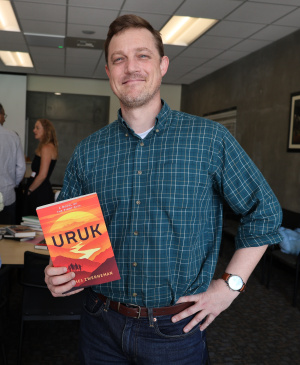
When James Zwerneman ‘11 spotted a copy of his novel Uruk on one of the tables, he stopped mid-conversation, pointed at it and grinned. “Hey, there’s my book.” It was a moment repeated countless times throughout the evening, as around 200 alumni of UC Irvine’s M.F.A. Programs in Writing gathered to celebrate the program’s 60th anniversary.
The books on those tables represented only a fraction of what the program has produced over six decades. Even the crowd itself captured just a portion of the over 600 writers the program has fostered.
The reunion also marked the retirement of Professor of English Michelle Latiolais, M.F.A. ‘88, the program’s longstanding director and, like so many in that room, an alumna herself.
Small by design
The Programs in Writing was established at UCI in 1965, when only a handful of M.F.A. programs existed in the country. Today there are hundreds, with UCI appearing on list after list of the best among them. And yet the program itself remains largely unchanged by the decades.
“Over 60 years, there has been so much continuity in this program,” Latiolais, author of Widow, a collection of stories shortlisted for The Believer Book Award and the novel Even Now, which received the Gold Medal for Fiction from the Commonwealth Club of California, told the crowd. “And it matters.”

The philosophy behind that continuity was established from the beginning. As Latiolais explained to attendees, the program’s founders – Oakley Hall, Donald Heiney and James McMichael – believed that to advertise a writing program was to make the false claim that you could produce or certify a writer. “There are no Irvine products,” she said. “But what the university and its faculty could do was to support an artist to make their work, and UCI and its writing faculty have done precisely that.”
From more than 400 applicants each year, a maximum of twelve new students are enrolled: six in fiction and six in poetry. The program is kept deliberately small to allow one-on-one teaching and the kind of sustained, individualized attention that is rare at a university of UCI’s scale. Students receive full funding for the duration of their enrollment, freeing them, for two to three years, to “make writing their life.”
The graduation rate is 100%. Sandy Mueller, the program’s former administrator, ensured this by “hunting students down,” as Latiolais recalled, and “holding their hands through the bureaucratic rigamarole” that writers, left to their own devices, would cheerfully ignore. Both Mueller and Professor Emeritus James McMichael, the poetry program’s founder who dedicated 47 years to UCI, were at the reunion.
An environment that can’t be duplicated
What the program asks of its students is specific. Its stated aim is “passionate precision, character and stamina.” These qualities are tested weekly in the workshop, where students and an instructor sit around a table and spend several hours dissecting (or, some might say, decimating) each other’s work with an intensity that alumni describe as exhilarating, harrowing and impossible to forget.
Impossible to forget is not a figure of speech. Writers who graduated decades ago can still recall exact phrases from these sessions that shifted how they saw their own work.

Nick Martino, M.F.A. ‘23, whose debut poetry collection Scrap Book won the Alice James Editor’s Choice Award in 2024, still remembers being told his early poetry was “drunk on its own music.” Bee Sacks, M.F.A. ‘19, author of City of a Thousand Gates, describes it as “an environment that can’t be duplicated.” Years out from graduation, Sacks recalls that “someone said something casually that changed my life.”
The bonds formed in that small room have a way of outlasting the program itself. Charmaine Craig, M.F.A. ‘99, author of Miss Burma, which was longlisted for the National Book Award, offered what became the evening’s recurring sentiment. “Michelle is the director of many of our lives,” she said. “She has a gift for making you feel like your work matters. Like you matter.”
Matt Sumell, M.F.A. ‘07, author of the story collection Making Nice, was more granular. The program’s support, he shared, showed up not in grand gestures but in “a series of small interventions,” like faculty who noticed when something was wrong and were there for you as a person, not just a writer. “Michelle still reads my work,” he said, “invites me over for dinner, tells me she’s proud of me.” He paused. “This kind of care doesn’t show up on brochures. But it makes a difference.”
The people who walk through the door to receive that care come from every conceivable background. John Kim, M.F.A. ‘13 spent six years as a lawyer before entering the program. Ferdia Burke, currently in his second year, worked 25 years in construction before arriving at UCI. Michael Krikorian, M.F.A. ‘80 had studied geology as an undergraduate and worked as a car mechanic before changing course entirely.
“The support in this place is crazy,” Burke told the crowd, who all nodded in agreement. “The culture is different here.”

A formidable reputation
Since its founding, the program has never spent a cent on advertising. Its reputation has been built entirely by its alumni, and that reputation is formidable.
Three graduates have won Pulitzer Prizes: Richard Ford, Yusef Komunyakaa and Michael Chabon. Others have become household names, their books on our shelves and their stories on our screens – Alice Sebold’s The Lovely Bones, Aimee Bender's The Particular Sadness of Lemon Cake, David Benioff’s adaptation of Game of Thrones.
Graduates have earned nearly every major literary distinction the field offers. Even Hal Stern, UCI’s provost and executive vice chancellor, stopped by the reunion; a self-described Chabon fan, he admitted he had hoped to spot him in the crowd.

The program shows no signs of slowing down. Jen Beagin’s novel Big Swiss found a passionate collection of readers on “BookTok” and is in talks to become an HBO television series. Danzy Senna’s Colored Television was a New York Times Notable Book of 2024. The same year, Oprah announced Lara Love Hardin’s The Many Lives of Mama Love as her first Book Club pick.
A slideshow of alumni books ran throughout the evening, and still only scratched the surface. Kim summed it up simply: “This program has produced giants.”
Finding their way back
Some alumni have returned not just as visitors but as faculty, teaching in the same program that trained them. Hector Tobar, M.F.A. ‘95 – Pulitzer Prize winner, Guggenheim Fellow and author of Deep Down Dark, which became a film – is now a professor of English and teaches in the literary journalism program.
Joshua Ferris, M.F.A. ‘03, whose novel To Rise Again at a Decent Hour was the first American novel ever shortlisted for the Man Booker Prize, will soon return to Irvine to teach. Rebecca Schultz, M.F.A. ‘17 now serves as the program’s director of undergraduate creative writing. They are among many who have found their way back.
After more than three decades, Latiolais is stepping back from the program she once entered as a student. Professor of English Claire Vaye Watkins takes over as director in the fall.
In that time, Latiolais has never wavered from what the founders believed: that the only thing the program could honestly offer a writer was the time and space to do the work. The rest, as that room full of writers proved, would take care of itself.
Interested in reading more from the School of Humanities? Sign up for our monthly newsletter.