
Alumni Through the Decades: 1960s
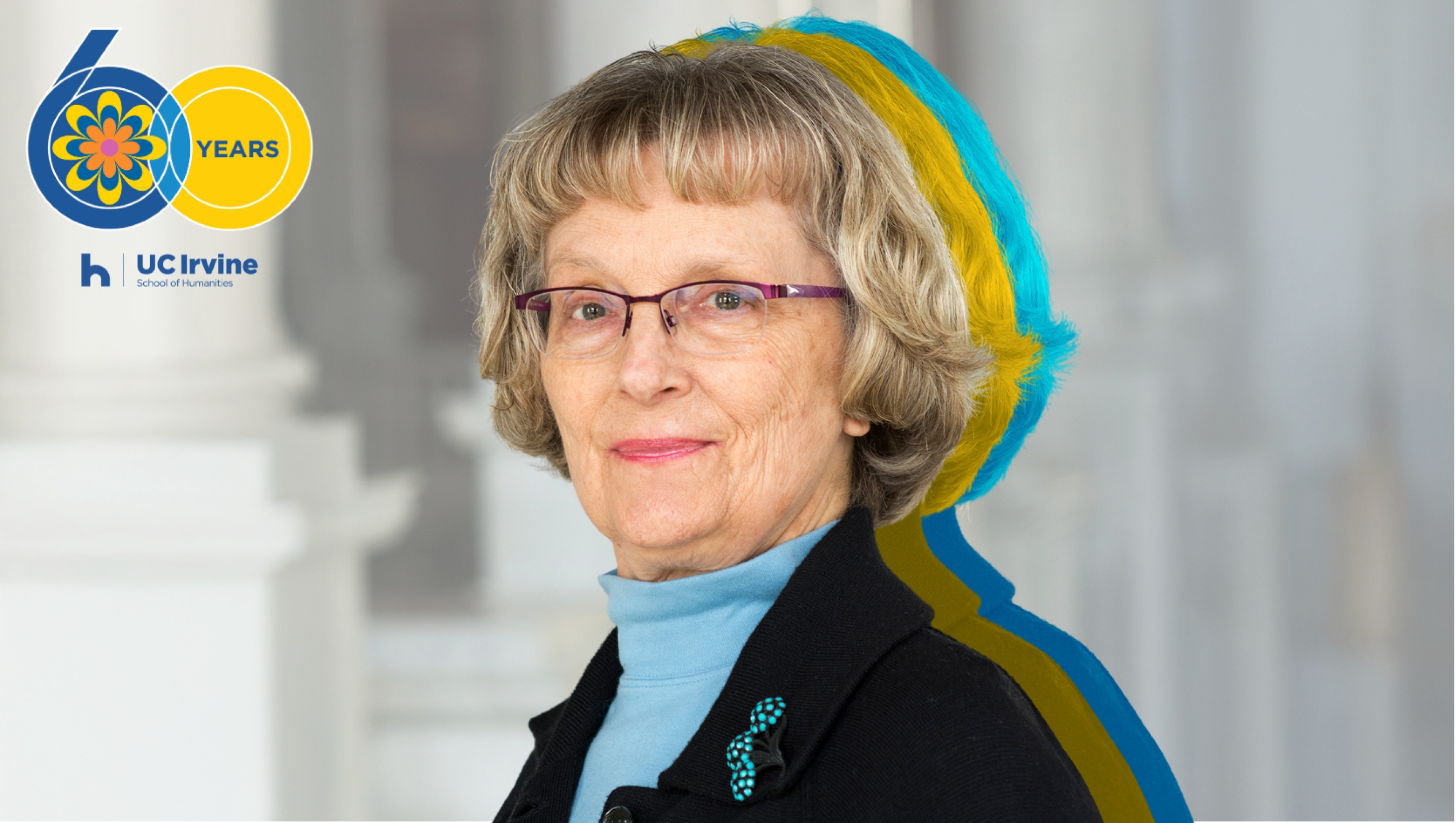
In 1965, UC Irvine and the School of Humanities opened its doors to the first Anteaters. As the campus celebrates its 60th anniversary, we're launching an alumni series featuring a graduate from each decade, starting with Judith Vormittag Nierman '68 (B.A. English), a member of UCI's first graduating class.
After graduating, she earned a master's degree in English from the University of Maryland at College Park. Her career journey took her through varied roles across the United States, from substitute teaching to authoring bibliographies to writing for the Library of Congress, but all shared a common foundation: her UCI humanities education.
As a member of UCI's first graduating class, what are your thoughts on how the university has grown and changed over the decades?
I am glad to see the school as large as it is. I am also glad to see the diversity in architectural styles. The original buildings were great for their time, but tastes change.
What made you choose UCI for your education, given how new the university was at the time?
When I was in high school at Santa Ana Valley High School, the requirements to get into the University of California provided a guide for many of us. Also important was the fact that UC selected mainly from the top 10 percent of a graduating class. The newness of the school was not something I considered at the time. Since the school was not open when I graduated from high school, I went to Santa Ana College before going to UCI. That school was not the best preparation for a major university, but I managed the transition. I had to live at home because there was not enough housing for undergraduates, and anyone who lived within a 15-mile radius (I think) was not eligible for housing.
What was student life and the campus culture like when you attended? Do you have any fond memories?
I did not participate in traditional student activities because I was busy with a job at an industrial supply business and with reading for my classes. Try reading a Victorian novel in a week! The campus culture was proud of the fact that there were no sororities or fraternities. This was during the Vietnam War and so-called hippies, dogs and earth mothers were everywhere, even at Irvine.
An interesting if not fond memory was some sort of protest in the English Department that resulted in everyone arriving for class in the morning to discover tree branches and other vegetation hanging from the ceiling. I think the thought was that if Berkeley could have protests, so could UCI. Truly fond is the memory of working at night in the basement of the library in a photo lab making material required for an education class.
I remember preparing all summer before my senior year for the comprehensive examination required by the English Department. This exam went on for two days. If you did not pass after two tries, you could not graduate with an English degree. The exam covered anything between Beowulf and Eugene O'Neill. We were given a reading list. A majority of those who took it did not pass. Some transferred to Chapman College to graduate. This exam is probably no longer required. I also remember a professor in graduate school assigning articles to students to review. Mine was in French. When I told the professor that I did not read French, he replied that it was assumed that all graduate students in English read French. I found another student to go over the article with me. The price of this was inhaling the smoke from her Marlboro cigarette that was constantly in her mouth. To this day I do not read French. But in the Copyright Office I was the proofreader for Office documents in Spanish.
How do you think your UCI education impacted your life and career path after graduation?
I was a young female who graduated during the dividing point between dinosaurs and career women. I got married after one year of grad school at Irvine and began moving back and forth across the country in support of my husband's service in the Navy. This went on for five years. When you were not in a place permanently, it was impossible to have a career apart from selling Mary Kay or Avon. I did neither. I took a graduate seminar on Hemingway at the University of Georgia in Athens, Georgia. I did substitute teaching in high schools in Connecticut, California and Maryland.
When we lived in Annapolis, Maryland, I got a master's in English from the University of Maryland at College Park. I drove 10,000 miles for that degree. When we were a civilian family with two small children, I renovated our house in Albany, California, and probably earned more money than if I had had a regular job. I also published two books that were bibliographies of works about Edna St. Vincent Millay and Floyd Dell. I gave a copy of each to the English Department library. Back on the East Coast in Rockville, Maryland, I did home instruction for Montgomery County Public Schools and then got an editorial position with the Audubon Naturalist Society in Chevy Chase, Maryland. When my children were older I went to work for the federal government. I retired as a writer/editor for the Copyright Office in the Library of Congress. To me, it was the best possible job, and I loved it. But how did my UCI education help during all this? I can't say. I was and am proud of it. I worked hard for it.
What advice would you give current UCI students and soon-to-be alumni?
The only advice I have is to work as hard as you can and be grateful for the opportunity you have.
Is there anything you'd like to add?
There was only one female professor in the English Department while I was a student at UCI. This in spite of the fact that the majority of English students were females. The lady professor taught linguistics. I bet there are more women professors now. I also imagine there is now more help in getting a job with an English degree. We had no idea what we could do with it. People talked about selling encyclopedias (no joke!!).
Not only the students but also the professors were making the transition from a semester system to the trimester scheme. One professor told my class that his lesson plans were all made for a semester, and we would have to adapt to that.
I would also like to mention Professor Howard Babb. His dictum that "rewriting is rethinking" has served me well.
Interested in reading more from the School of Humanities? Sign up for our monthly newsletter.