
Congo, cobalt and the cost of connection
By Nikki Babri
The sounds come before anything else: metal striking stone, water moving somewhere below, the voices of men working in a space so cramped and deep that light barely reaches them. Brief flashes from headlamps reveal bodies, clad in only t-shirts and with no protective gear in sight, packed into a narrow shaft hundreds of feet underground. In the glimpses the flashlights allow, it is hard to tell how many people are down there. “I’d say there are even 20,000 of us,” one digger says. When their shift ends, they pull themselves up by rope.
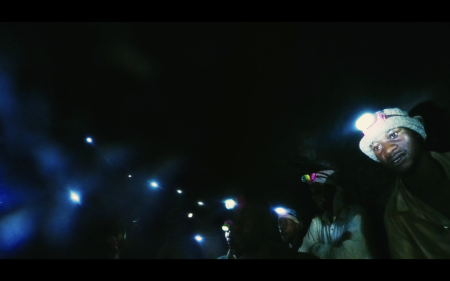
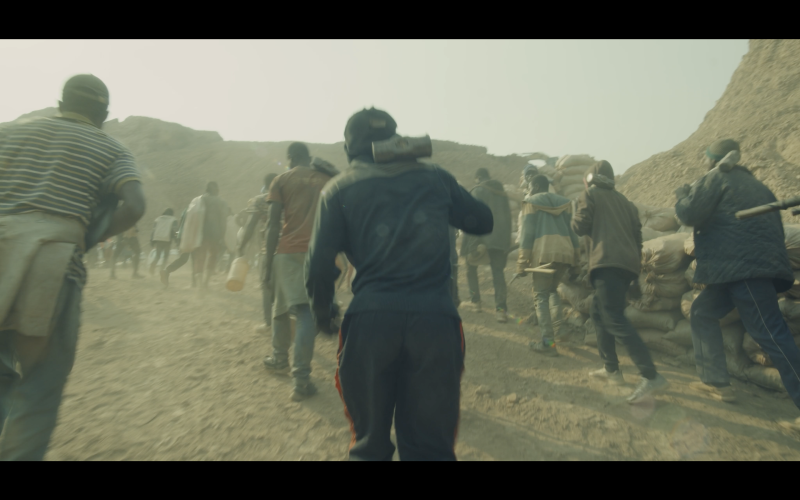
This is Ndjimu (2025), the latest film from Congolese filmmaker Petna Ndaliko Katondolo and winner of International Film Festival Rotterdam’s 2026 Best Documentary Short Award. The title, meaning “hole” in Swahili, is a nod to the thousands of honeycomb-like excavations that pepper the mining landscape. The film descends into the artisanal cobalt mines of the Democratic Republic of Congo, where thousands of people dig by hand for the mineral that powers our phones, laptops, electric vehicles and countless other technologies.
In February, UC Irvine’s School of Humanities hosted Ndjimu’s North American avant-première as part of a tribute to the late Kenyan literary giant and UCI Professor Ngũgĩ wa Thiong’o, Translating Ngũgĩ: From Here to There, From Then to Now. Co-sponsored by the Office of the Humanities Dean, Film and Media Studies, Comparative Literature and the Alec Glasser Center for the Power of Music and Social Change, the evening also featured previously unseen footage of Ngũgĩ speaking in both English and Swahili.
Ngũgĩ spent the final decades of his career as Distinguished Professor of Comparative Literature and English at UCI. One of the most consequential writers and intellectuals of the twentieth century, his novels, plays and essays challenged the dominance of European languages in African literature and helped lay the groundwork for postcolonial studies. He is perhaps best known for arguing that African writers must return to their mother tongues to reclaim cultural and intellectual sovereignty. It is a principle Katondolo echoes in his own work, insisting that Congo’s story should be told from the inside out.
A descent into the unseen
Katondolo was born and raised in Goma, a city in eastern Congo that sits at the foot of an active volcano and is at the center of one of the longest-running conflicts in modern history. Throughout his career, his films have focused on what global narratives tend to ignore, from displacement and gender-based violence to the relationship between land and identity. “Making Ndjimu was an attempt to see the gap between the byproduct and where a product comes from,” he explains, “bringing the experience of what powers our houses, our cars and our phones closer to where we are.”
To make the film, Katondolo descended into the mines himself, reaching about ten meters before turning back. The diggers go far deeper. In the film, a man can be heard saying, “Look at me, I’m now 85 meters deep,” as he continues to propel himself farther into the earth.
Absent are the images that Western audiences have come to expect from Congo; there are no photographs of child labor, no images of landslides, no footage designed to reduce human suffering to spectacle. “What I didn’t show is exactly the clichés that everybody wants to see,” Katondolo shares. “I am interested in the question of what is beyond those dangers? What makes people take those risks up to that level?”
The answer is a system in which land has been seized by multinational companies, profits flow to corrupt governments and ordinary people are left with no choice but to risk their lives. So Katondolo went where no politician would ever go – deep into the mines – to show the people who the system renders invisible, and to treat cobalt not as a commodity but as a living material with memory, one whose story has been told by everyone except the people inside it.
A mwalimu and a friend
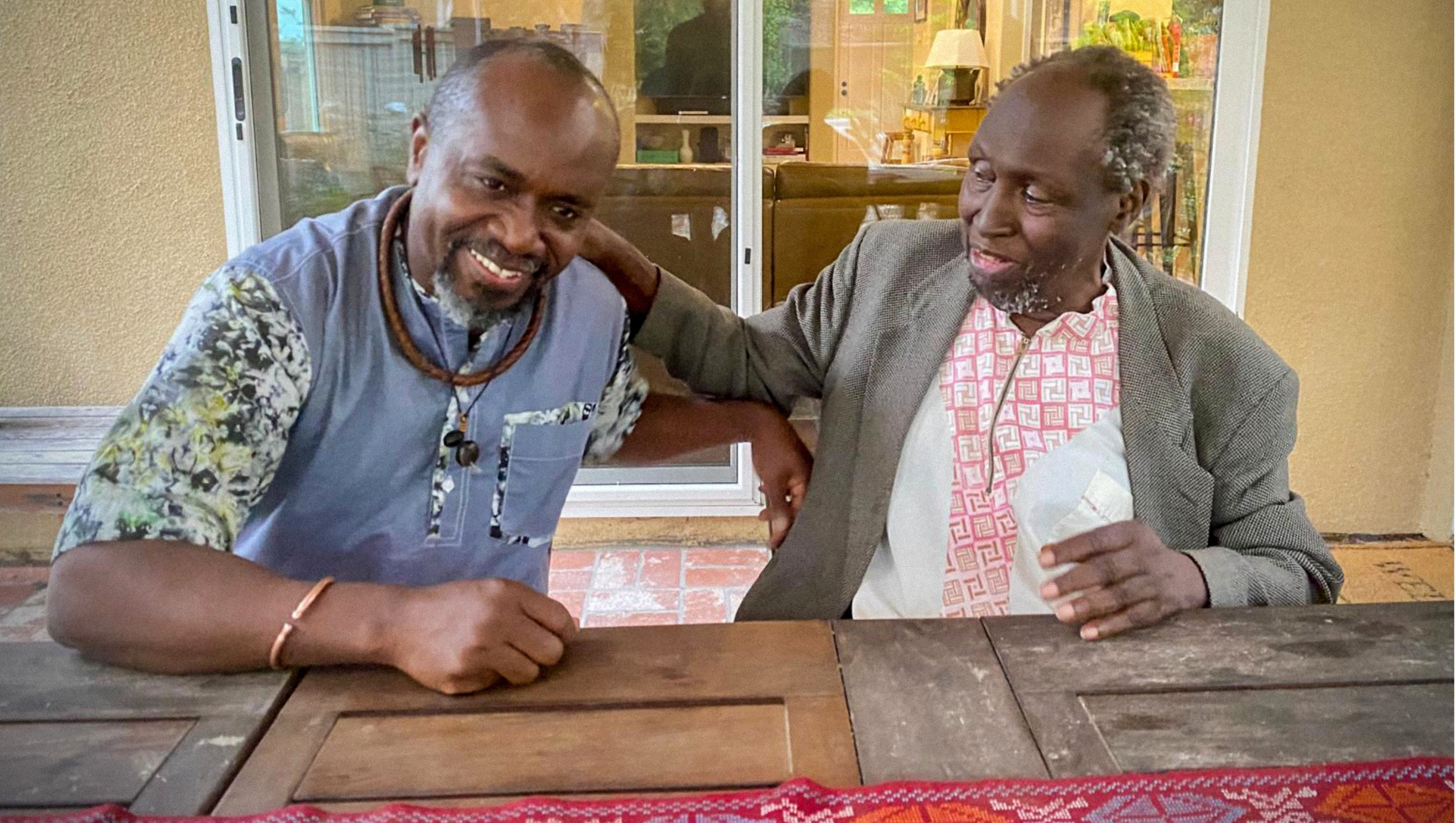
Storytelling also serves as the basis for Katondolo’s relationship with Ngũgĩ. He first encountered the writer upon Ngũgĩ’s historic return to Kenya after years in exile, brought in as a documentary camera operator to film the homecoming. Someone handed him Ngũgĩ’s work to read in preparation. “I think I finished all of his books in a week,” he recalls.
Katondolo describes the relationship as a combination of mentor, father figure and friend. It was defined as much by laughter and phone calls as by intellectual exchange. Ngũgĩ’s persistent joke was that he had always wanted to be a filmmaker. “Every time we would sit and talk, he would say, ‘Man, you’re a filmmaker – I always wanted to be a filmmaker,’” Katondolo laughs.
When he had questions about a new idea, Ngũgĩ was the person he called. “If he hasn’t said it’s good, that means I still have work to do,” Katondolo remembers. “If he says it’s fantastic, then I’m okay.” At an award ceremony in San Francisco, Ngũgĩ, upon learning Katondolo was in the audience, stopped his own acceptance speech to call him out by name and share a story about their friendship. “This was his moment,” Katondolo says, “and he made it about someone else.”
It was characteristic of a man who never lost sight of where he came from. “Compared to other intellectuals, Ngũgĩ came from rural areas. He was talking about peasants, about farmers, about land-based practitioners,” Katondolo explains. “That’s where I’m from. All of his work was rooted in that real, local place.”
Coming together
It’s a philosophy that Katondolo has spent more than two decades putting into practice. In 2000, he co-founded the cultural institution Yole!Africa. In many East African languages, yolé means “come together,” the call cattle herders use to gather their flocks when danger is near. The center provides a similar place of refuge for Congolese youth looking to tell their own stories.

Yole!Africa offers training in filmmaking, theater, music, painting and dance, and also runs farms where students practice seed-keeping and cultivate indigenous plants. It was founded on the conviction that Congo must be understood not only as a place of wealth to extract, but as one that holds wisdom to share.
While Goma has endured years of conflict and natural disasters, Katondolo is clear that instability has never been an excuse to stop this work. The challenge, as he sees it, is not how to respond to emergencies but how to build structures that function within them. “Once you respond to an emergency, there is no space left for thinking,” he explains. “You’re just in survival mode.”
When rebels seized Goma at the start of 2025 and most organizations shut down, Yole!Africa did not close. Over 80 families sheltered at the arts center while community members drove out to find food and water, their cars struck by bullets. What made this possible, Katondolo says, was not infrastructure but grassroots community – the sense of belonging to a group of people who would check on you, find food for you and build a roof over your head.
Solidarity as investment
The release of Ndjimu could hardly be more timely. A recent minerals deal between the United States and the Congolese government has set off a scramble among artisanal miners who fear the agreement will close the informal mines that sustain entire local economies. Just two weeks before the UCI screening, over 200 miners were buried in a collapse while digging for coltan, another precious mineral. Katondolo invokes an East African proverb to describe Congo’s position: “When two elephants fight, it is the grass that suffers.”
What Katondolo wants from American audiences is not guilt. It is recognition and action grounded in solidarity rather than sympathy. He is insistent that Congolese people not be cast as victims. They are, he says, agents of their own stories, people who have developed forms of knowledge and resilience that the rest of the world is only beginning to recognize. “We are interconnected far more than we think. Solidarity is investment, not charity,” he emphasizes.
A decade ago, Katondolo would travel to the United States and ask whether anyone knew where Congo was or what was happening in the country. Most did not. Last week, he posed the same question to a class at UCI. Every hand went up. That, he says, is the kind of transformation that actually matters – not a policy handed down from above, but a change in who gets to speak and who is listening.
Interested in reading more from the School of Humanities? Sign up for our monthly newsletter.