
How Disneyland explains modern life
By Rebecca Tuhus-Dubrow
In August 1948, Walt Disney paid a visit to the Ford Motor Company’s River Rouge plant in Detroit. He marveled at the industrial automation of the assembly lines. Just days later, Disney wrote a memo laying out his vision for an amusement park in Southern California.
When Disneyland opened in 1955, its rides and animatronics featured many of the same technologies that had redefined the factory: sensors, limit switches and magnetic tape. As Roland Betancourt argues in his new book, Disneyland and the Rise of Automation: How Technology Created the Happiest Place on Earth (Princeton University Press, 2026), “Disneyland is fundamentally a factory.” Its product is “the experience itself.”
In the book, Betancourt explores themes of labor and leisure in the postwar era, as well as concerns about automation that sound uncannily familiar today. He helps readers to see Disneyland in a whole new way – but also asks what Disneyland can tell us about broader shifts in society. “We think Disneyland is trivial,” he notes. But studying its history enables us to understand “how automation technologies become a part of our life.”
From Byzantine art to Mickey Mouse
For Betancourt, UC Irvine Chancellor’s Professor of art history, writing about Disneyland was not an obvious choice. His training is in Byzantine art; his previous book, published in 2024, was The Secrets We Keep: Hidden Histories of the Byzantine Empire.

But Betancourt sees a through-line between his background as a medievalist and his current project. “When I am thinking about, say, a medieval manuscript that’s being used in some sort of religious service, I’m thinking about the senses, sound, the whole experience,” he explains. This attunement to holistic sensory experience is one that he also applied to his analysis of Disneyland – only this time the objects of study were the Matterhorn Bobsleds and the animatronic Evil Witch who pops out on the Snow White ride.
Betancourt grew up in Florida, so “theme parks are in the blood,” he says. Not long after joining UCI, he visited Disneyland with a friend. He soon bought a pass and began making regular trips. “I just started spending a lot of time in the park,” he recalls, “treating it as a place to get away in Orange County and walk around outdoors.”
But he was always paying attention with the eye of an art historian. Eventually, he started noticing “the motions of rides, the jerkiness, the moving around, the sound, all these things you sublimate and don’t pay attention to. And that’s really what brought me to the question of automation.”
In 2019, he began teaching a popular class titled “Disneyland: Art, Architecture and Operation.” He eventually drew on much of the material in the class for the book.
Automation anxieties
In 1955, “automation” – a term that had only recently been coined – was one of the top issues of the day, discussed ad nauseam in books, on television shows and at conferences. Would it free workers from drudgery or lead to mass unemployment (or both)? That year, Congress held the first in a series of hearings on the subject. In October, even the comic strip Blondie weighed in: one character’s boss tells him, “You know you can be replaced by a machine, don’t you?”
When Disneyland launched the same year, it brought the technologies of automation into a new context. Betancourt contends that, by adapting these technologies for entertainment purposes, the park made them more palatable. “My argument is that in large part, the theme park helped to ameliorate our concerns – a ‘stop worrying and love the bomb’ type mentality,” he says.
He points out parallels to today. “You can worry about AI causing you to lose your job,” he says. “But you’re also probably going to pick up ChatGPT and ask it what to eat for dinner. And you might be talking to a chatbot because it’s fun. And so the minute that these technologies become entertainment of different sorts, they lose their edge.”
Studying the “happiest place on Earth”
To research the book, Betancourt estimates that he’s visited Disneyland more than 200 times. A number of employees became close friends.
Spending time there revealed two seemingly contradictory aspects of the park. On the one hand, “You are spending many days at a place that is people’s once-in-a-lifetime vacation destination,” he notes. On the other hand, “It’s very much a neighborhood park. People who have annual passes come and hang out for a few hours. They see the fireworks, they walk around and have a churro and don’t ride a ride. There’s a public square feeling to it, which I really appreciated.”

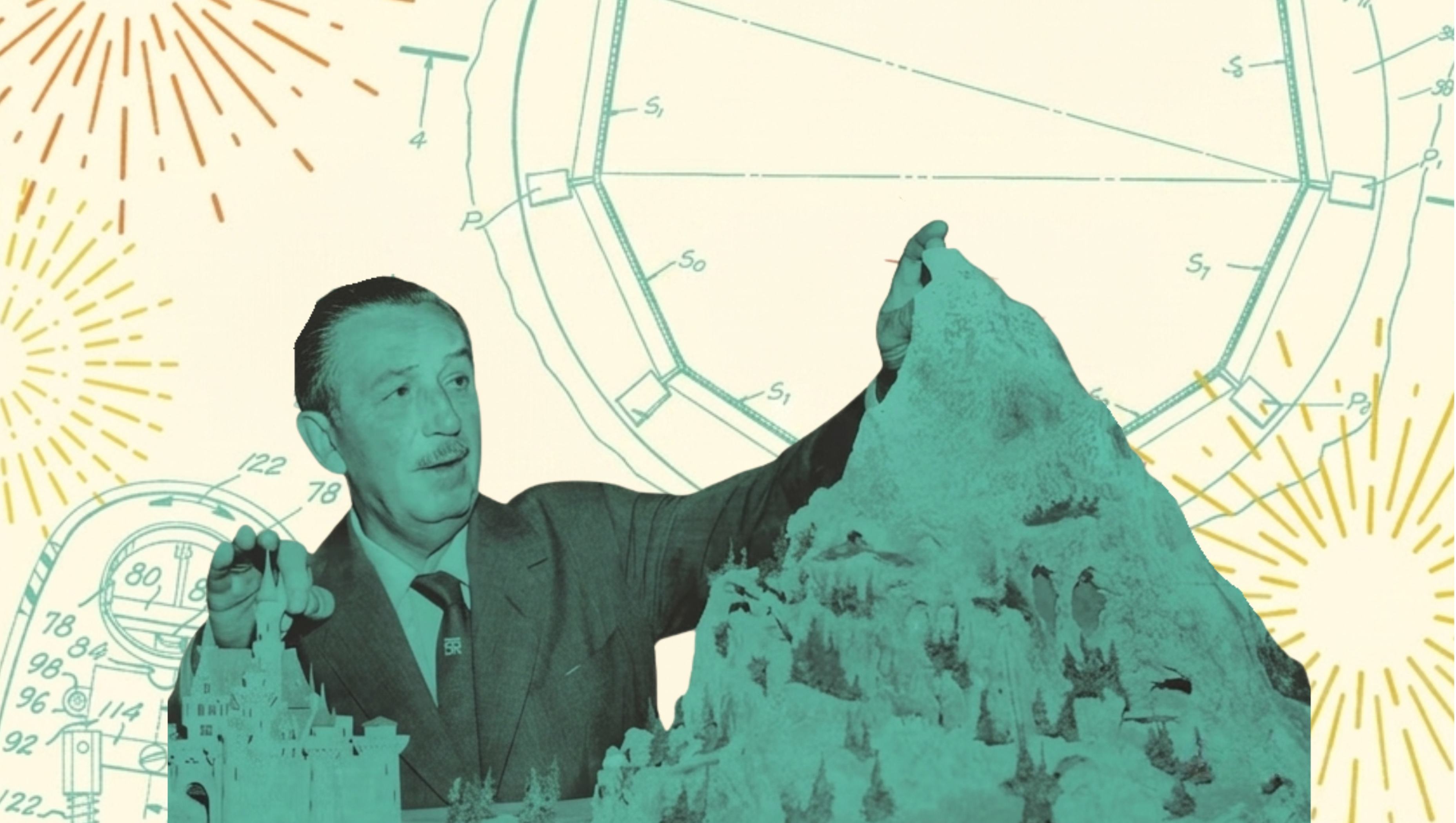
Betancourt also consulted numerous archives, from the Historical Society of Long Beach to the Cleveland Tramrail Archives. “I took every conference opportunity to go to small, random archives,” he says. The book is interspersed with photographs and other images, such as newspaper ads, comic strips and patent drawings.
He spent hours poring over patents for the ride designs. “I’m not an engineer,” he says. “These patents might be six pages but they would take me six hours to read.” But it was important to him to really grasp the technology and, in turn, make it legible for readers. “So many of these technologies are wholly invisible to us,” he explains. For example, components called “programmable logic controllers” are ubiquitous in modern life; they are in every Disney ride, and they also run our traffic lights and factories. “I hope that people will be able to read this book and gain a sense of the importance of these technologies and a way of recognizing them,” Betancourt says.
Looking ahead
After a two-year leave, during which he conducted research at the National Gallery of Art in Washington, D.C., Betancourt will return to UC Irvine in the fall. He will resume teaching his course on Disneyland.

The class fulfills the requirement for general education arts and humanities, but also for science and technology. “It’s not just a generic Disney history class. It is harder than most students might think since we are learning all about the history of technology and how it works.”
He also has a second book on Disneyland – a more scholarly work – coming out next year. Another project in the works investigates the history of corporate training.
His current book, Betancourt stresses, is not just for Disney fans. It offers a window into the concerns of a previous era that are startlingly relevant today. He notes that in the 2020s, the lines between labor and leisure continue to blur in new ways. Corporations now design cutesy robots that can fist-bump their human colleagues. “Now, it is the factory machine that becomes the Disney character, rather than the other way around,” Betancourt writes.
But, for readers who do love Disneyland, the book does contain some advice: “The next time you ride a theme park attraction, I want you to close your eyes and just feel.”
Rebecca Tuhus-Dubrow is a writer in residence at UC Irvine's Forum for the Academy and the Public.
Interested in reading more from the School of Humanities? Sign up for our monthly newsletter.