

Why the future of law may start in the humanities
By Robert Munrayos
At UC Irvine, the humanities explore art, literature, culture and history. And they’re also a launchpad for leadership in some of today’s leading professions. Nowhere is this more evident than in the practice of law, where a growing number of humanities alumni are shaping the future of justice, public policy and advocacy.
Over the past decade, dozens of UC Irvine humanities graduates have taken their interpretive, ethical and analytical training into courtrooms, classrooms and civic institutions. From litigators and policy advocates to paralegals and public defenders, these alumni are demonstrating that majoring in the humanities isn’t just relevant to the study and practice of law, it establishes a strong pathway to it.
As Dean Tyrus Miller of the School of Humanities explains, “The humanities help foster a rich understanding of people’s motivations, cultures and histories, which in turn, nourishes the ethical practice of law. They also remind us time and again that law begins and ends with people–a crucial insight for the pursuit of justice for individuals and for our society as a whole.” This steady flow from humanities to law reflects a simple but powerful truth: the core skills nurtured in a humanities education – such as critical reasoning, persuasive writing, cross-cultural understanding and empathy – are among the most essential tools in legal practice.
A strong outlook for new attorneys
UC Irvine’s local momentum reflects broader national trends in legal education and employment. According to the U.S. Bureau of Labor Statistics (2025), the median annual wage for lawyers in 2024 stood at $151,160, with employment projected to grow four percent between 2024 and 2034, as fast as the national average. Approximately 31,500 new openings are anticipated each year, driven by retirements and increased demand in fields like environmental regulation, civil rights and data privacy.
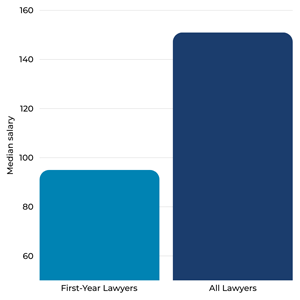
Meanwhile, recent law graduates are entering a strong job market. According to the National Association for Law Placement, law school graduates of the class of 2024, the largest graduating class in over a decade, exceeded legal industry predictions on job placement. In 2025, the American Bar Association and the National Association for Law Placement reported that over 84 percent of 2024 law graduates secured positions requiring bar passage within ten months, the highest rate on record. At UC Irvine, humanities alumni are keeping up with the pace of these national trends. Data from the School of Humanities shows a growing number of graduates entering law school and securing legal positions. Alumni have gone on to serve in positions such as Appellate Court Attorney, Senior Deputy City Attorney, Associate Counsel and Public Advocate. Their employers span from Public Advocates and the Supreme Court of the U.S. Virgin Islands to municipal and appellate offices across California.
Paving the path to legal careers

In a formal move to support its students' transition into legal careers, the UC Irvine School of Humanities has partnered with UCI Law to launch two new law pathways. The first program allows admitted humanities students to access a $30,000 per-year scholarship at UCI Law through the School of Humanities Scholarship Program. In the second program, qualified humanities students can enter a 3+3 accelerated program that allows them to complete a B.A. and J.D. in six years rather than the traditional seven.
Across the entire University of California system, UC Irvine is the first campus to establish a formal, structured partnership between its law school and school of humanities.
Yong Chen, professor of history and associate dean for curricular and student services in the School of Humanities, describes the collaboration as deeply mission-driven: “The partnership demonstrates our shared commitment to making educational and professional attainment accessible to all students.” He underscores that for many humanities undergraduates, including a significant percentage that are first-generation students, this program removes both financial and institutional barriers to pursuing legal careers.
Humanities in action

For Nancy Sotomayor (B.A. Women’s Studies and Psychology and Social Behavior ’11; J.D. ’16), the humanities were central to her legal formation. Now a litigator at Akerman LLP in Los Angeles, she credits her undergraduate studies with shaping her approach to justice. “My humanities education taught me to take into account the intersections of race, gender and socioeconomic status,” she explains — skills that have proven invaluable in litigation and client advocacy.

Similarly, Isra Shah (B.A. English ’06; J.D. ’12), an alumna of UCI’s signature Humanities Core program, traces her own trajectory back to the intellectual training she received in the humanities. Humanities Core's “Laws and Orders” theme introduced her to the interplay between law, literature, philosophy and film. “The most rewarding and challenging academic work I’ve done was in Humanities Core,” she recalls. “It shaped how I think and how I solve problems collaboratively, skills I use every day in my legal work.” She now works as a municipal attorney advising local governments.

These patterns continue with current students as well, including Joseph Cheung (B.A. English and Chinese Studies ’22; current UCI Law 2L); his path from the humanities to the law was intentional from the beginning. His undergraduate research on Hong Kong’s cultural identity sparked an enduring interest in international law and human rights. “Events like the UCI Forum for the Academy and the Public’s ‘Global China in an Anxious Age’ helped me realize that the questions I cared about as a humanities student around justice, identity and power are the same ones I want to explore in law school and beyond.”
Of course, not all of our humanities alumni who have gone on to legal careers are recent graduates. After Margaret Kreeger '75 (B.A. Spanish Literature) graduated from the School of Humanities, she continued on to earn her J.D. from the University of San Francisco and was admitted to the California Bar in 1982. Margaret has had a long and successful legal career, including working as a Trial Attorney for the U.S. Equal Employment Opportunity Commission (EEOC) and as Special Assistant to the EEOC Chairman. After a legal career spanning four decades, Margaret never forgets her humanities roots. As the 2024 commencement speaker for the UC Irvine School of Humanities and School of Social Ecology, she shared, “My path from literature to law might seem a departure. But, at its core, it was about advocacy and fighting for voices unheard and stories untold.” Margaret’s journey reinforces how a foundation in the humanities can cultivate critical thinking, empathy and an understanding of human experience – qualities that are necessary for an impactful legal career.
These stories highlight what many legal educators and professionals have long recognized: that the humanities are not irrelevant to law, but foundational. As the legal field evolves to address complex social, environmental and technological challenges, the interpretive and ethical capacities developed through the humanities will only become more vital. At UC Irvine, the humanities continue to prepare students not just to understand the world but to change it. And for a growing number of graduates, that change begins with the law.
Robert Munrayos is a second-year Ph.D. student in UC Irvine’s Department of Latin American and Iberian Cultures. His research explores the intersections of science fiction, gothic literature, indigenous studies and queer studies, with a particular focus on how these genres envision futurity, the posthuman and alternative conceptions of identity. He is especially interested in how speculative storytelling challenges cultural norms and expands the possibilities for collective imagination and social transformation.
Interested in reading more from the School of Humanities? Sign up for our monthly newsletter.