

Meet Our Centers and Clusters: Center for Critical Korean Studies
Editorial Note: The Humanities Center helps to manage over twenty research centers and clusters directed by faculty and graduate students in the School of Humanities. This feature article is the first of an occasional series spotlighting the work of our centers and clusters. Image above: Group photo from the Korean American & Asian American Studies Curriculum Conference, Nov. 19, 2022.
Building Communities of Care, Critique, and Collaboration: The Center for Critical Korean Studies
BTS Army – over 90 million strong. Squid Game – one of Netflix’s most popular TV series of all time. Along with K-pop and K-dramas, and Korean food and fashion, cultural scholars have been researching the global popularity of Korean culture, reflected on UC Irvine’s campus. In 2021, hundreds of students participated in a Squid Game-focused event and played Korean games like ddakji as represented in the show.
Appreciation for Korean culture is one consideration of UC Irvine’s Center for Critical Korean Studies (CCKS), an internationally-recognized academic hub for Korean art, culture, and history. They provide a variety of programs for faculty, graduate and undergraduate students, and the surrounding community. Joseph Jonghyun Jeon, professor of English and Asian American Studies, is the current faculty director. Joo Hoon Sin, program manager, oversees the execution of the variety of events hosted by the center – including scholarly talks, film screenings, and conferences – that are also supported by a graduate student fellow in Anthropology, Juwon Lee. Jeon notes the value of the center: “When CCKS was founded in 2016, we had a number of faculty across the campus working in Korean Studies. What we needed was a coherent structure to connect the various parts of campus and to provide a focal point for interdisciplinary exchange between Korean Studies scholars in different departments.”

The campus center currently has seven core Korean Studies faculty and nine affiliated faculty from a variety of Social Science and Humanities departments, including East Asian Studies, English, History, and Art History. “We're always trying to put on things that reflect or complement the things that our faculty are doing,” Jeon said. The diversity of the faculty’s areas of expertise opens opportunities for the center to explore Korean Studies in new directions, employing interdisciplinary approaches and asking questions that extend beyond a more traditional model of “area studies.” The emphasis on “critical” in the center’s name reflects the use of Korea-specific critical theories and practices to explore the political, economic, and social relationships within the field of Korean studies.
Each spring, the center hosts an annual New Books in Korean Studies colloquium. Last year’s colloquium welcomed six authors who had recently published books relating to Korean history and culture. Some examples include Se-Mi Oh’s academic history, City of Sediments: A History of Seoul in the Age of Colonialism, and Mirinae Lee’s historical fiction, 8 Lives of a Century-Old Trickster, which won the 2024 William Saroyan International Prize for Writing. Regional collaborations and visiting scholars connect UC Irvine to larger discussions about Korea, both locally and internationally. “The point of CCKS, as it is with any center, is to connect people and ideas, be it faculty and students on campus or the campus to the surrounding community,” Jeon said.
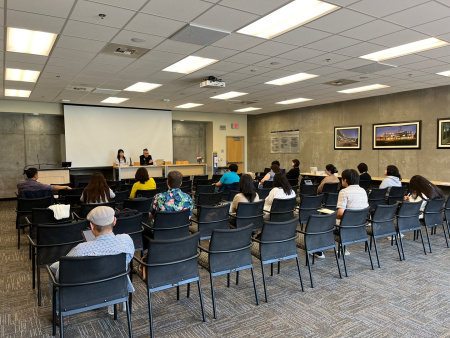
Since its inception, the need to connect faculty expertise with student and community interest has grown CCKS into a leading Korean Studies center in the United States. CCKS received two prestigious international grants in 2021 from the Academy of Korean Studies and from the Korea Foundation. These grants have been instrumental in funding CCKS’ programming, academic curriculum, and faculty positions. Funding from individual donors and private foundations bolsters the center’s academic scholarships and community programming. “It’s a really great environment and one that’s growing,” Jeon said. “We’re very fortunate to have some very generous support from alumni and other community members.”
CCKS also supports on-campus graduate and undergraduate education. Graduate students are an important part of the vibrant intellectual network at UC Irvine and actively involved in center events. The center promotes graduate student development through fellowships and research grants, and it helps shape the undergraduate and graduate Korean Studies curriculum. Content courses from Fall 2025 included “Korean Cinema" and “Sounds of Korea.” Courses in Korean language are the second-most popular on UC Irvine’s campus, with about five hundred students participating annually. Student development is a key way CCKS helps expand knowledge about Korean Studies beyond UC Irvine and into public discourse.
Beyond the academic community, there is a growing demand for opportunities to appreciate and participate in Korean studies in the broader geographical context. Orange County is home to the second-largest Korean American population in the United States, and CCKS works to meet community needs and interests through its events and outreach programs. One of the center’s primary goals is to foster public appreciation of Korean history and culture, and community members are often at conferences and film screenings. Annually, CCKS collaborates with university departments and centers, including the Humanities Center, to produce UCI’s Lunar New Year Festival, which is free and open to the public.
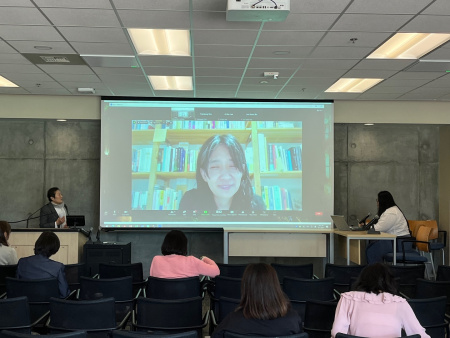
Contemporary Korean Women’s Literature and Cinema conference (May 30-June 1, 2024).
Both on UC Irvine’s campus and in the surrounding community, interest in Korean studies continues to rise. The center plans to expand its curriculum in the next academic year and add more faculty and affiliated faculty. To adapt to changing global issues, the center is moving towards a focus on Korean art and environmentalism in 2026, and will have a conference on Korea and environmentalism in the Spring. The Center for Critical Korean Studies is constantly evolving to meet the needs of the scholars and community it serves.
More information on the Center for Critical Korean Studies can be found on their website.
Written by Melissa Marion, English 2026, Fall Communications and Marketing Intern