

How I See It: Intellectual Diversity (And Some Discontents)
By Tyrus Miller
The views expressed here are solely those of the author and do not represent those of the Regents of the University of California, the UC Irvine campus, or the UC Irvine School of Humanities.
The idea of “intellectual diversity”—or “viewpoint diversity,” a term often used interchangeably with the first—has recently been much discussed and debated. As a working definition, we might consider the following: in a community of inquiry (a classroom, for instance), materially different approaches, backed by reasons and evidence, should be present, acknowledged as legitimate parts of the discussion, and actively engaged. This diversity of approaches should, the definition also entails, lead to substantially richer understanding and teach better habits of reasoning that can later be applied in other situations and on other problems. I use the alternate term “viewpoint diversity” primarily when referring to the specific language of the edited volume, organizations, and policies that I discuss below. These definitions, however, leave open an important distinction that I will explore further: whether intellectual diversity is a state of affairs to be measured, a position to be claimed, or a practice to be sustained.

The higher education organization Heterodox Academy, founded in 2015, has made increasing viewpoint diversity part of a broader effort to renew higher education. To advance that goal and, presumably, to exemplify its commitment to civil intellectual dialogue from diverse perspectives, Heterodox Academy’s president, John Tomasi, and Heresy Press founder Bernard Schweizer edited Viewpoint Diversity: What It Is, Why We Need It, and How to Get It, published by Heresy Press in March 2026. The collection consists of short, accessible essays. Tomasi is a professor emeritus of political science at Brown University; Schweizer is a professor emeritus of English at Long Island University. I will return to this volume later, but for now I want only to highlight the cheerleading tone of its title, a tone shared by several contributors. Much in the discussion of intellectual diversity in Viewpoint Diversity is reasonable and worthy of consideration; some points simply seem like good sense and would find few challengers in academic quarters. How many professors would oppose a classroom in which students actively think through and discuss complex issues related to the course materials? Who does not recognize that humility about one’s intellectual limitations and the unfinished state of knowledge in a field is necessary to continued discovery? Wouldn’t most of us agree that good scholarship and teaching require fair engagement with the principal lines of debate in a field? Indeed, one reason intellectual diversity has gained traction as an institutional project, it seems to me, is that it has associated itself with such academic near-truisms—or, let us say, consensual background beliefs—and presented itself as moving in the direction of intuitive good sense.
My skepticism begins when these appeals to good sense are set against an exaggerated picture of the contemporary university as ideologically uniform and institutionally adrift. I fail to see how the cause of intellectual diversity is served by caricaturing the problems, behaviors, or institutional tendencies its advocates claim to address. We have a shared interest in honestly identifying and analyzing the adaptive challenges that higher education faces in the present and future; that analysis should rest on evidence more robust than anecdotes about a chair who was once mean to someone or an ungenerous question asked at a talk. A good starting point would be sociologist Neil Gross’s Why Are Professors Liberal and Why Do Conservatives Care?, a sober, evidence-based study of the leftward tilt of American academia. We also have cause to examine what else might be hiding in the viewpoint-diversity package beneath the brown-paper wrapping of unexceptional good sense.
One might well come away from the volume with the impression that viewpoint diversity is an all-purpose answer to a sweeping range of problems extending well beyond academia: the loss of public trust in institutions, including colleges and universities; the erosion of respect for expertise; internet and social-media trolling; free-speech dilemmas in contemporary society; the decline of literary standards in contemporary fiction; political polarization; and extremism. This range seems symptomatic of a tendency among academics to overestimate both the agency of the academy and the reach of their own good—I mean this unironically—work within it. The university is certainly not socially powerless, but neither can it bear the burden, in its present or some future form, of being the comprehensive answer to so many weighty social problems. Advocates of intellectual diversity would do well to define the specific institutional problems they intend to mitigate and to exercise considerably more of their much-vaunted intellectual humility about how far particular measures might move the dial in a positive direction. Viewpoint diversity cannot plausibly be the principle that “changes everything.” Rather than ask whether intellectual diversity is simply good or bad, I will follow three uses of the term: as an auditable state of affairs, as a prestige-bearing position, and as a practice of inquiry. The question is when the first two obscure or undermine the third.
The ambiguity becomes especially consequential when the language of intellectual diversity passes from academic advocacy into government policy. Heterodox Academy has established itself as the most prominent academic advocate of viewpoint diversity, while organizations such as the American Association of University Professors, founded in 1915 to advance academic freedom and shared governance, have been skeptical both of the concept and of its application in the current context. The AAUP, along with many individual commentators, has expressed particular concern about how the language of intellectual diversity has been deployed by state governments in Ohio, Indiana, Florida, Texas, and elsewhere, as well as by the federal government during the second Trump administration, to intervene directly in university curricula and faculty evaluation.
A prominent example is Indiana’s Senate Enrolled Act 202 (SEA 202), which took effect on July 1, 2024. The law requires public institutions to establish policies concerning intellectual diversity, free inquiry, teaching, and faculty evaluation. Proponents framed it as an urgent response to an academic status quo in which ideological orthodoxy was said to produce “indoctrination” rather than the education of students. SEA 202 permits students and employees to file complaints alleging noncompliance and requires such complaints to be considered in faculty reviews and promotion and tenure decisions. Because the law also subjects tenured faculty to recurring review on these grounds, it weakens the customary protection tenure provides for academic freedom. These concerns are not merely hypothetical. By December 31, 2024, Indiana University had handled nine complaints concerning eight situations and dismissed thirty-seven additional anonymous submissions as frivolous protest filings. Even a complaint eventually dismissed for lack of merit may exert a chilling effect before its resolution, encouraging faculty to avoid controversial material rather than risk investigation. To its credit, Heterodox Academy declined to support SEA 202, arguing that its provisions presented constitutional and practical problems. My point, however, is that the term has proved portable across contexts and has been amenable to uses its academic advocates disavow.
An even more sweeping example of political intervention in matters previously understood to fall largely within university self-governance and faculty academic freedom is the letter of April 11, 2025, addressed to Harvard President Alan Garber and Penny Pritzker, senior fellow of the Harvard Corporation, by representatives of the Trump administration’s General Services Administration, Departments of Education, and Department of Health and Human Services. One demand is especially relevant here: it treats viewpoint diversity as a condition to be audited in every institutional unit and corrected through admissions and hiring. The letter demanded, in part:
Viewpoint Diversity in Admissions and Hiring. By August 2025, the University shall commission an external party . . . to audit the student body, faculty, staff, and leadership for viewpoint diversity, such that each department, field, or teaching unit must be individually viewpoint diverse. . . . Every department or field found to lack viewpoint diversity must be reformed by hiring a critical mass of new faculty . . . ; every teaching unit found to lack viewpoint diversity must be reformed by admitting a critical mass of students. . . . If the review finds that the existing faculty . . . are not capable of hiring for viewpoint diversity, or that the relevant teaching unit is not capable of admitting a critical mass of students with diverse viewpoints, hiring or admissions . . . shall be transferred to the closest cognate department, field, or teaching unit that is capable of achieving viewpoint diversity.
Here viewpoint diversity is explicitly treated as a state of affairs that each unit either possesses or lacks and that external supervision can recalibrate through admissions and hiring. Unlike Columbia, Brown, and Northwestern, all of which entered agreements with the administration that included institutional reforms and financial commitments, Harvard refused. In its April 14 response, the university characterized the demands as exceeding the government’s authority and declared that it “will not surrender its independence or relinquish its constitutional rights.” On September 3, 2025, the U.S. District Court for the District of Massachusetts vacated the administration’s funding terminations, concluding that they violated the First Amendment and the Administrative Procedure Act, although the broader conflict continued. On Harvard’s website devoted to the federal lawsuits, President Garber is quoted as saying, “No government—regardless of which party is in power—should dictate what private universities can teach, whom they can admit and hire, and which areas of study and inquiry they can pursue.” Garber carefully specifies “private.” Public colleges and universities, as the Indiana example shows, face a different legal and political configuration. Yet the underlying principle he expresses—that governments should not dictate teaching, hiring, admissions, and inquiry—deserves defense there as well, even if the relevant legal doctrines operate differently.
Governmental appropriation, to be sure, does not exhaust the intellectual case for diversity. Returning to Viewpoint Diversity: What It Is, Why We Need It, and How to Get It, I cannot offer an essay-by-essay review, but even as I make critical remarks, I recommend the book in whole or in part to interested readers. Several pieces are thoughtful and, though addressed primarily to academics, are accessible to a broader public. Given the current political and institutional interest in viewpoint diversity, the book may also find some currency in policy and legislative circles. I found particularly thought-provoking Hollis Robbins’s “Viewpoint Diversity in the Age of AI,” which asks what viewpoint diversity might mean when generative artificial intelligence can produce simulations of innumerable perspectives and arguments at the press of a button. When “generated diversity,” as Robbins puts it, is available on demand, how do we continue to foster genuine diversity in learning and thought?
Also insightful is Bernard Schweizer’s “How Publishing Lost the Plot on Diversity,” which pulls back the curtain on publishers’ outsourcing of manuscript review to a largely invisible group of uncredentialed "sensitivity readers" charged, according to standards not visible to the public, with flagging putatively offensive content, characters, or words. Schweizer also scrutinizes another hidden filter on literary discourse in contemporary publishing: Amazon’s categorization system for new book listings. That system forces publishers to slot books into reductive and sometimes irrelevant identity categories, classifying male and female authors in inexplicably divergent ways. Schweizer is persuasive because he analyzes a specific mechanism that may narrow thought; he does not need intellectual diversity to serve as a universal cure for everything that mechanism produces. Both his essay and Robbins’s have the virtue of getting beyond a certain academic myopia to ask how intellectual diversity in universities relates to broader technologies and institutions: the rapid introduction of large language models, in Robbins’s case, and the corporate deployment of pseudo-diverse categories in the interest not of authors, their creative works, or readers but of Amazon’s control of the book market, in Schweizer’s. Both examples show why a multiplication of generated perspectives or market categories should not be confused with genuine intellectual plurality.
I would also highlight Yascha Mounk’s observation, in “The Paradox of Infinite Voices and Narrow Minds,” that diversity matters not only within institutions but also between different kinds of institutions. He treats this as an occasion to imagine new institutions; I would take the point in a more diagnostic direction. The history of American higher education in the nineteenth and twentieth centuries saw a proliferation of institutions across the United States: new endowed private universities, land-grant public universities, liberal arts colleges, technical and teachers’ colleges, historically Black colleges and universities, tribal colleges, theological and denominational colleges, and, later, for-profit and online universities. For reasons involving demographics, student demand, changing religious belief, employment markets, and financial pressures, this interinstitutional diversity has in key respects diminished as colleges and universities have merged or closed. Among elite private and leading public research universities, meanwhile, competition has produced convergence on a common model as institutions seek to move a few places upward in the U.S. News & World Report, Times Higher Education, and QS rankings. At this level, the “uncommon excellence” of one institution evidently has much in common with the “uncommon excellence” of another—by both design and desire. Each leading institution might ask itself: Are we going to keep jostling and weaving a few places ahead on that single congested road of “uncommon excellence”—jammed and crawling like the L.A. freeway, whether one is driving a Harvard Ferrari or an X-State Prius—or are we willing to think seriously about our distinctive destination as an institution and discover a less traveled road to it? Convergence at the top also shapes the intellectual networks that elite institutions sustain, and the volume itself offers an unintended illustration.
Mounk’s point invites a reflexive question about the volume that contains it. The editors of Viewpoint Diversity appear to have sought to model their commitment in the range of contributors and viewpoints represented in the book; how intellectually diverse, in fact, is the collection? In one respect, it does well, gathering authors from literary studies, political science, religious studies, history, public health, law, sociology, and other disciplines, with contributions by journalists, writers, and interfaith leaders complementing those of academics.
I was nevertheless curious about how the participants were selected and who they were. The editors’ introduction neither explains the selection process nor provides the customary contributor biographies. Having read the book, I remain in the dark about that process, but a brief online search gave me a clearer sense of the contributors’ disciplines, locations, and areas of activity. Besides supplying basic information I might have expected from the editors, the search was revealing in another respect. The volume contains nineteen contributions, including Jonathan Haidt’s preface, and, with two co-authored pieces, twenty-one contributors. Of the fifteen contributors with current or emeritus faculty appointments, eleven are affiliated with private universities, predominantly elite East Coast institutions; Harvard alone has three contributors, with others at the University of Pennsylvania, Brown, Johns Hopkins, and New York University. Four public institutions are represented: the University of Nebraska, the University of Illinois Urbana-Champaign, the University of Utah, and the University of California College of the Law, San Francisco. The wider contributor network likewise clusters along the Eastern Seaboard, especially in New York City, where Heterodox Academy itself is based.
I should be clear that I do not intend this observation as a “gotcha,” nor do I think the editors should have followed a “one of these, one of those” logic in soliciting contributors. I am not even claiming that the book would necessarily have been better with a different or larger roster. Institutional affiliation and geography in themselves do not determine anyone’s viewpoint. They do, however, reveal the relatively narrow institutional networks through which a volume making broad claims about higher education was assembled. If Viewpoint Diversity is any indication, those networks are in certain respects quite narrow. A project presenting itself as a corrective to academic narrowness should therefore examine the institutional narrowness of its own networks, with less self-congratulation about its “heterodoxy” and more humble reflection on how its intellectual diversity might be deepened when it speaks for the much wider range of American higher education.
In 2024, Musa al-Gharbi published a remarkable book entitled We Have Never Been Woke: The Cultural Contradictions of a New Elite. It is not a comfortable book to read as an academic. Al-Gharbi treats elite political commitments as a form of symbolic capital: commitments that may be sincere and substantively worthwhile yet still confer prestige, authority, or material advantage on those who profess them. He neither doubts the sincerity of the beliefs academics hold nor, in many cases, the worthiness of the causes they support. Rather, he identifies—and supports with empirical evidence—a persistent structural inconsistency between their stated beliefs and their actual behaviors, their relationships, and the institutional arrangements from which they benefit. Although his focus is primarily on the role that left-wing social-justice discourse has recently played in competition among elites for symbolic capital, I suspect that some of the current sound and fury surrounding intellectual or viewpoint diversity can be understood in similarly disenchanted terms. Read through Al-Gharbi’s framework, intellectual diversity can function less as a condition of inquiry than as a position within the competition for symbolic prestige. This is one reason it is not irrelevant or merely ad hominem to consider the institutional and geographic locations of the volume’s contributors. That interpretation does not establish bad faith on anyone’s part. It does suggest that while the symbolic vehicles of academic competition may change, the competition itself may remain depressingly familiar—and far removed from a panacea for what ails American society.
That diagnosis may seem pessimistic, but it does not exhaust the idea. If the first reduction turns intellectual diversity into a state to be audited, this second turns it into a position to be performed. A classroom experience suggested a third possibility: intellectual diversity as a practice rather than an audited state or professed position. I will conclude, then, with a story about a quieter and more local form of intellectual diversity—one less easily made into a program or organization, but perhaps more important than a newly minted slogan of academic politics.
In one session of a recent UC Irvine School of Humanities course and workshop Social Media Storytellers: On Academic Freedom, twelve undergraduates discussed with me the relation between intellectual diversity and academic freedom. They read two sharply opposed essays: Lisa Siraganian’s “Seven Theses Against Viewpoint Diversity,” published in the American Association of University Professors’ journal Academe; and Samuel J. Abrams’s response, “Seven Theses for Viewpoint Diversity,” published on the American Enterprise Institute’s website.
I can offer only a brief summary of their respective arguments. Siraganian argues that the production and transmission of knowledge in universities have as their primary goal the pursuit of truth, not the cultivation of expressive freedom or other values that would necessarily make viewpoint diversity desirable in every instance. Although diverse perspectives may sometimes serve the pursuit and communication of truth, she contends, broad areas of scientific or scholarly consensus exist in which entertaining a wide range of perspectives may hinder that goal. Externally compelled recognition of different viewpoints solely for the sake of diversity may also restrict the academic freedom of professors to present evidence-grounded judgments about what does and does not constitute a legitimate perspective on a given subject. Abrams, by contrast, characterizes Siraganian’s view as too absolute and argues that viewpoint diversity and truth-seeking are more complementary than she allows. On broader sociological and political grounds, he also considers her rejection of viewpoint diversity to be self-defeating: universities, he suggests, are reaping the public distrust they have sown, and a defensive circling of the academic wagons will invite more of the political interference Siraganian seeks to repel. Siraganian thus treats viewpoint diversity chiefly as an external obligation to represent perspectives, one that may conflict with evidence-based disciplinary judgment; Abrams treats it chiefly as a condition of truth-seeking and public trust. They disagree not only about its value but about what the term names.
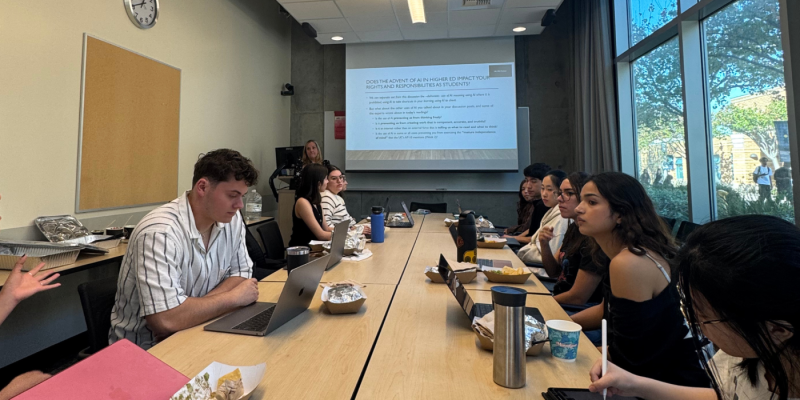
Both pieces were written by experienced and rhetorically proficient academics, and both authors advance compelling points. The students expressed varying degrees of agreement and disagreement with the arguments arrayed in this point-counterpoint form. Given the inclusive appeal of “let’s bring everyone’s perspective to the table”—especially for humanities students accustomed to grappling collectively with ambiguous texts, actions, and events—I would characterize our initial discussion as tipping toward the argument for viewpoint diversity. As we proceeded, however, a new and rather surprising facet of the debate began to appear. We asked: Does it really make sense to think of intellectual diversity as something we are “for” or “against”? Doesn’t the exclusive nature of an either-or argument somehow contradict the idea of intellectual diversity itself? If intellectual diversity is a value worth pursuing, might it be better understood as a process—a persistent dialogue-in-divergence—than as a thing we choose or reject at a single moment? The problem was not that either author reached a judgment; inquiry requires judgment. It was that the two opposed judgments were presented as though choosing between them exhausted what intellectual diversity could mean.The numbered-thesis form—thesis deriving from a Greek etymon meaning “to set down” or “put in place”—sharpened the opposition, but it also fixed each side’s definition before the exchange began.
Our lack of a verdict was not paralysis. It followed from a clearer understanding of the different meanings in play and of what each position placed at stake. Rather than hurry toward a decision, we examined the multiple ways intellectual diversity was being used and considered what those divergent uses entailed. The authors had adopted initial stances that left little room for dialogue and were, in important respects, talking past one another under the cover of a shared term. Although we found it difficult to take the firm stand their paired theses demanded, our deliberations disclosed another dimension of intellectual diversity that we valued: the practice of recognizing and avoiding the readymade rhetorical trenches that can foreclose richer understanding before an exchange begins.
Looking back, I am struck by how little of this classroom discussion is captured by the first two senses of intellectual diversity distinguished at the outset. Legislative and audit regimes treat intellectual diversity as a measurable state of affairs: a distribution of views across a syllabus, department, or student body that can be counted, found wanting, and recalibrated. Academic status contests can turn it into a prestige-bearing position: a stance of heterodoxy that one embodies and professes against an imputed orthodoxy depicted in broad strokes. The classroom suggested a third sense—a practice of testing terms, evidence, and assumptions without prescribing the outcome in advance.
What the students arrived at was neither a measurable distribution nor a claimable position. They did not settle on a set of views to adopt; they became wary of adopting any view too soon, including their own. They issued no theses, adopted no definitive positions, and produced nothing that could be reported to an auditor or listed on a CV. That absence of a claimable result was part of what made the exchange invaluable. Intellectual diversity was not something we possessed or certified but something we enacted together, with consequences no one had determined in advance. Its value lay in what we came to understand through an exchange whose direction no participant could individually control. A habit of noticing when a debate has been foreclosed in advance exists only in the doing. I cannot offer this experience as a program—that would only be to set it down as one more thesis. I mention it as an anecdote, rather, to recall that some of the most valuable forms of intellectual diversity may be those to which no one gets to lay claim.
Works Referenced:
Musa Al-Gharbi, We Have Never Been Woke: The Cultural Contradictions of A New Elite (Princeton University Press, 2024).
Neil Gross, Why Are Professors Liberal and Why Do Conservatives Care? (Harvard University Press, 2013).
“Federal Lawsuits” Webpage, Harvard University: https://www.harvard.edu/federal-lawsuits/ .
Letter from Federal Government Agencies to Alan M. Garber and Penny Pritzker, Harvard University, 11 April 2026: https://www.harvard.edu/research-funding/wp-content/uploads/sites/16/2025/04/Letter-Sent-to-Harvard-2025-04-11.pdf.
John Tomasi and Bernard Schweizer, Viewpoint Diversity: What It Is, Why We Need It, And How To Get It (Heresy Press, 2026).