
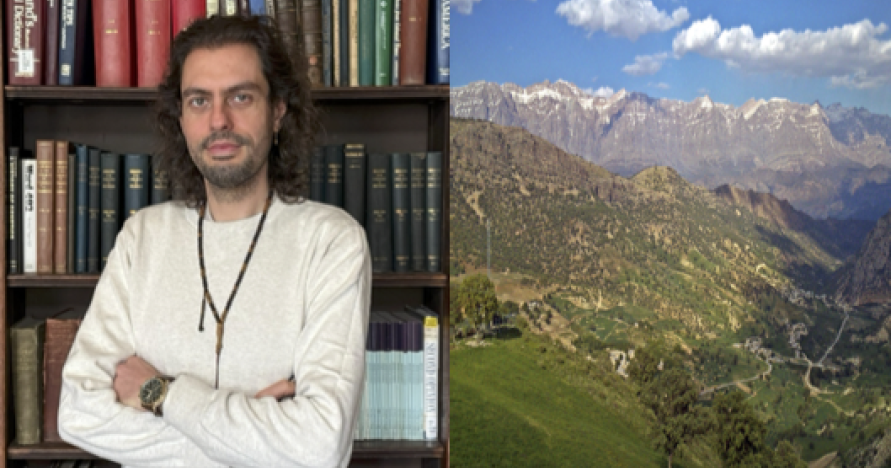
The Cedars of the Zagros Mountains? Rethinking the Mesopotamian Evidence and its Connections with the Iranian Plateau
A talk by Gioele Zisa
Wednesday, April 29th | Time: 6:00 PM
Location: UCI Humanities Gateway #1341
Abstract
This lecture reconsiders the long-debated question of the location of the “Cedar Forest” in Sumerian textual traditions, with particular attention to its alleged association with the Zagros Mountains and, more broadly, the Iranian world. While royal inscriptions from the Akkadian and Ur III periods (3rd m. BCE) consistently locate the cedar forests in the northwestern regions of the Amanus, fully in line with the natural distribution of Cedrus libani, a limited number of sources appear to suggest an eastern setting, beyond the Zagros. Through an analysis of both royal and literary texts, including the Sumerian compositions on Gilgameš and Ḫuwawa, this paper argues that such eastern references should not be interpreted as reflecting a real geographical shift. Rather, they belong to a symbolic and ideological register in which the “mountain of cedars” functions as a marker of distance and alterity. By integrating textual evidence with ecological data, the study further demonstrates that the absence of cedar species in the Zagros region makes an eastern localization highly unlikely. At the same time, it explores how the term erin (“cedar” in Sumerian) may at times operate as a broader designation for coniferous trees. The paper ultimately proposes that the apparent “Iranian connection” of the cedar traditions reflects not a historical geography, but a shifting ideological landscape in which eastern regions, associated with mountains, precious materials, and cosmological liminality, are incorporated into a broader Mesopotamian spatial imagination.
Dr Gioele Zisa (PhD in Assyriology, LMU Munich 2018, and PhD in Cultural Anthropology, Palermo 2022) is Marie Skłodowska-Curie Postdoctoral Fellow jointly based at Sapienza University of Rome and the University of Pennsylvania. His project, PLANET (Plants in the Ancient Near Eastern Texts), investigates the relationships between humans and plants in 1st millennium BCE Mesopotamia.