
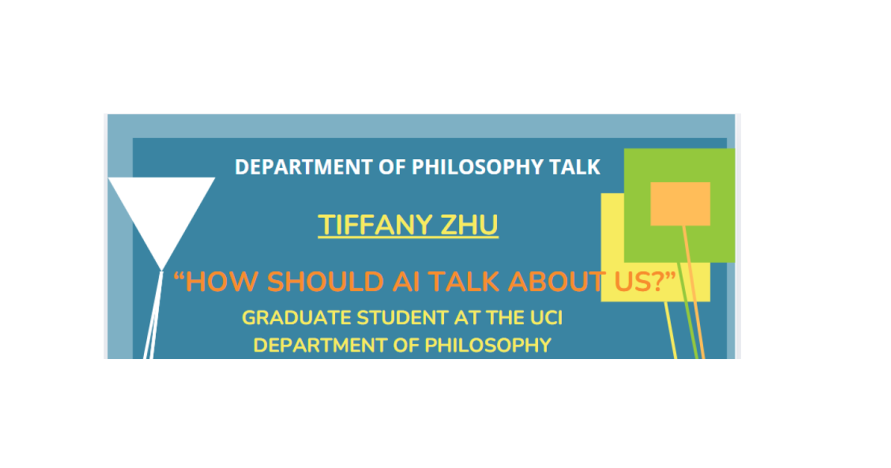
Department Talk: Tiffany Zhu (UCI)
This section contains archived content made available for reference, research, or recordkeeping purposes. These materials are not actively maintained and may not meet current accessibility standards, such as WCAG 2.1 Level AA. If you need assistance accessing this content or require an accessible format, please contact sohwebmaster@uci.edu. We are committed to ensuring access for all users and will provide accommodations promptly upon request.
How should AI talk about us?
Abstract
Generative artificial intelligence technologies are technologies of abstraction and prediction. When image generators are asked to depict groups like women and immigrants, the results almost invariably contain stereotypes. Language models face similar challenges when responding to inquiries about people based on social positions and group affiliations. Can genAI communicate truth-sensitive and justice-conducive information about groups of people in a world patterned by categorization and discrimination?
In this talk, I address this question by evaluating how ChatGPT responds to prompts containing generic generalizations such as “Do immigrants hold lower-paying jobs?” My analysis reveals troubling responses, including over-censorship and the minimization of structural inequities. I then sketch and evaluate five potential solutions for mitigating human-AI miscommunication and harmful social consequences. Overall, I advance three claims regarding the ethics of generative artificial intelligence. First, they are not set up to portray people and social reality in justice-conducive ways. Second, preventing or correcting flawed portrayals requires complex solutions. Finally, genAI technologies are not human, and that can be a good thing.